The following charts illustrate the decision tree to determine student eligibility for transitional math, as well as the determination of the appropriate transitional math pathway based on the availability of different courses and student interests. You are not required to use the decision chart or placement chart; they are provided to simplify the process of working through all the required criteria for determining transitional math placement.
Transitional Math Eligibility
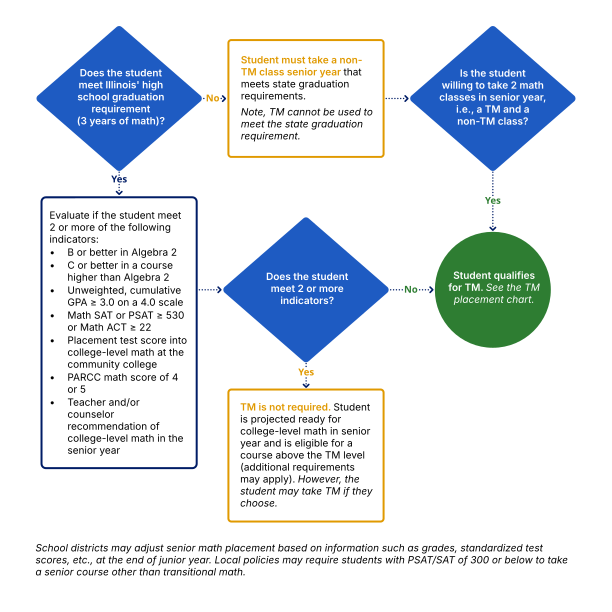
Transitional Math Placement
Students who meet the eligibility criteria for transitional math should choose a pathway based on their career interests and meta major. Use the following information to guide students with that decision.
Note: Students should take Transition to Quantitative Literacy and Statistics if they have not selected a meta major.
STEM
Audience
Student who will need College Algebra but is not ready to take it in the senior year.
Common majors/programs
Many AS degrees, most STEM majors, some nursing majors, elementary education, business degrees requiring business calculus, and university programs (BS or BA) that require College Algebra.
Additional considerations
Students will need to meet one of the following prerequisites:
- B or better in Algebra 1 or a higher math course
- Math GPA ≥ 2.5 (out of 4.0)
- Teacher verification of transitional college algebra prerequisite competencies
Quantitative Literacy and Statistics
Audience
Student who will need Liberal Arts Math (General Education Math) or Elementary Statistics but is not ready for dual credit, dual enrollment, or AP versions of those courses in the senior year.
Common majors/programs
Most AA degrees, such as history, art, philosophy, and English.
Additional considerations
Transition to QL/Stats is a better option for students who need College Algebra but feel Transition to STEM is too difficult. Many colleges have options to reduce time to complete College Algebra.
Technical Math
Audience
Student who will need multiple levels of technical math but is only ready for the lowest version.
Common majors/programs
Most AAS degrees, such as welding, fire science, construction, and culinary arts.
Additional considerations
If the community college has only one required technical math course, and it is the same as the transitional tech math course, it would be better to offer dual-credit technical math at the high school.